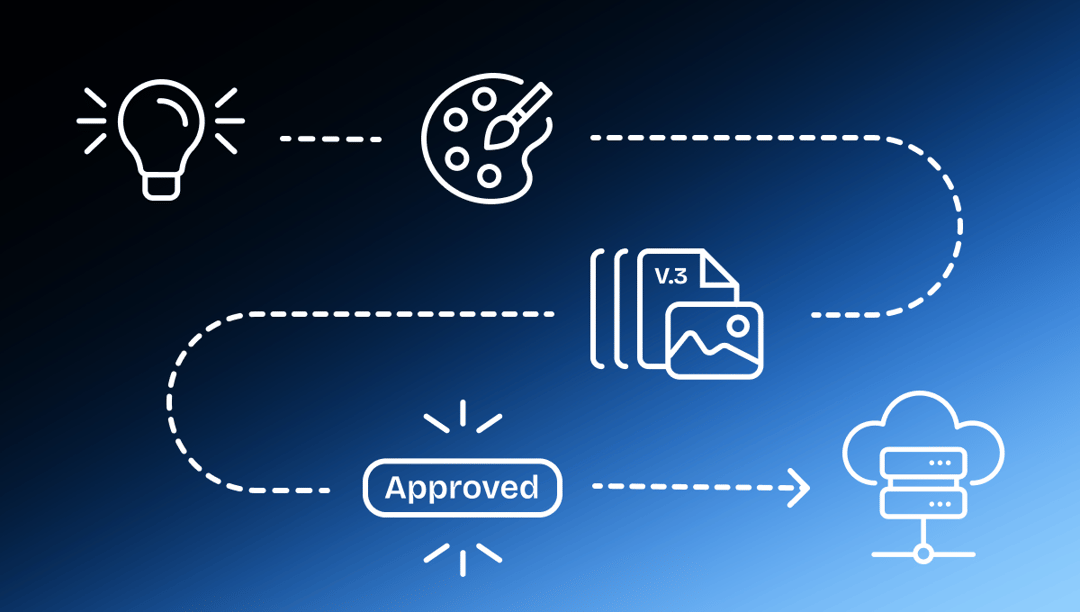
Creative asset management is the discipline of organizing, reviewing, approving, and distributing creative work across its entire production lifecycle (from first draft to final file).
It's not a storage problem. Most teams already have a place to store files.
The problem is everything that happens between "file uploaded" and "asset approved and ready to use":
- The feedback that’s scattered across email threads
- The version confusion
- The approval bottlenecks that push deadlines out by days
This guide covers what creative asset management actually involves, how it differs from related disciplines, and how to build workflows that get creative work out the door without the chaos.
TL;DR- Creative asset management governs the full production lifecycle. DAM handles storage, but the real friction lives in review, approval, and version control
- Different asset types need different review workflows. Video, design files, and regulated content all have distinct requirements
- The five pillars of creative asset management are centralized intake, structured review and approval, version control, compliance and audit trails, and performance measurement
- AI is changing how teams handle tagging, compliance checking, and bottleneck identification, but the workflow foundation has to be in place first
- Ziflow handles the review and approval layer that connects creative assets into a single, streamlined system
What we'll cover
Table of contents
Creative asset management vs DAM, MAM, and CMS
Creative asset management governs the production process before assets are stored in a DAM, broadcast through a MAM, or distributed through a CMS. Each system handles a different stage of the asset lifecycle, and confusing them is one of the most common reasons creative operations stall.
- A digital asset management (DAM) system is a storage and retrieval platform. It organizes approved, final assets (logos, brand files, finished campaign materials) so teams can find and reuse them.
- A media asset management (MAM) system does something similar but is purpose-built for video and broadcast media.
- A content management system (CMS) manages the publishing and distribution of content to websites and digital channels.
Creative asset management sits upstream of all three. It governs the production process before work ever reaches a storage or publishing system. That distinction matters because most teams looking for a creative asset management solution end up implementing a DAM and wondering why the workflow problems didn't go away.
The friction in creative operations lives upstream, in how work gets briefed, reviewed, revised, and approved before it reaches a DAM or goes live through a CMS.
Most teams don't have a storage problem. They have a workflow problem, and that's what creative asset management is designed to solve.
The 5 core types of creative assets and how their review workflows differ
The five core categories of creative assets are visual assets, video, written content, design source files, and campaign-ready materials. Each requires a review process tuned to its file type, audience, and risk profile, not a one-size-fits-all feedback loop.
Here's how the main asset categories differ:
|
Asset type |
Examples |
Key review requirement |
|
Visual |
Social graphics, display ads, print materials |
Pixel-level accuracy, brand consistency, and color verification |
|
Video |
Campaign films, social clips, product demos |
Frame-accurate feedback, audio sync, caption review |
|
Written |
Copy, scripts, long-form content |
Tone, accuracy, legal, and compliance sign-off |
|
Design source files |
Layered PSDs, AI files, Figma exports |
Version integrity, file structure, export readiness |
|
Campaign-ready materials |
Final ad sets, launch packages |
Cross-channel consistency, final approval documentation |
Each of these asset types benefits from a review process designed around its specific requirements, rather than a one-size-fits-all feedback loop that treats a video the same way it treats a headline.
A structured creative review process accounts for these differences from the start.
The 5 pillars of creative asset management
The five pillars of creative asset management are centralized intake, structured review and approval, version control, compliance and audit trails, and performance measurement. Getting all five working together is what separates a functional creative operation from one that's constantly firefighting.
Centralized intake
When creative requests arrive through email, Slack messages, and informal conversations, the information needed to actually execute the work gets lost or misinterpreted before anyone opens a design file.
Centralized intake means every request enters the workflow through the same structured channel, with a creative brief, defined deliverables, a timeline, and named approvers captured upfront.
That foundation makes every downstream step faster and less prone to rework.
Structured review and approval workflows
Review and approval are where most creative workflows break down and where the biggest efficiency gains are available.
The first decision is whether reviews should run sequentially or in parallel.
- Sequential reviews work best when one reviewer's feedback informs the next, as in legal review after creative sign-off.
- Parallel review works when multiple stakeholders can assess independently without their feedback conflicting.
Beyond structure, effective review workflows need conditional routing that adjusts based on asset type or risk level, SLA triggers that flag reviews approaching their deadline, and automated escalation when a reviewer hasn't responded in time.
Without these mechanisms, bottlenecks become invisible until a deadline is already missed. A well-designed review and approval process makes the status of every asset visible at every stage.
Version control
Version confusion is the most common cause of rework in creative operations. When reviewers aren't certain they're looking at the latest file, feedback gets applied to outdated versions, and work gets repeated.
Effective version control means previous versions are locked and accessible for reference, changes between versions are visible at a glance, and there's never any ambiguity about which file is current.
Compliance and audit trails
For teams in regulated industries, creative asset management isn't just about efficiency; it also becomes an unavoidable compliance requirement.
Healthcare teams managing medical, legal, and regulatory (MLR) review, financial services teams navigating disclosure requirements, and any team handling personal data under GDPR or FTC guidelines need documented evidence of who reviewed what, when, and what was approved.
Enterprise-grade requirements in these contexts include SOC 2 Type II and ISO 27001 certification, e-signature support, and complete audit trails that can withstand external scrutiny.
Performance measurement
A creative asset management system generates data that most teams never use. Cycle times, approval velocity, revision counts, and bottleneck frequency are all measurable and all actionable.
Tracking these metrics over time lets teams identify where work consistently slows down, whether that's a particular reviewer, a specific asset type, or a stage in the workflow that needs restructuring.
How AI is changing creative asset management
AI is changing creative asset management in four key ways: auto-tagging, automated compliance checking, change detection, and predictive bottleneck identification. Its value depends on having solid workflow foundations in place first.
- Auto-tagging uses machine learning to automatically apply metadata to assets, reducing the manual overhead of maintaining a library that is organized and searchable at scale.
- Automated compliance checking scans assets for regulatory issues, flagging missing disclosures, incorrect brand elements, or restricted content, before human reviewers begin, shortening review cycles and reducing the risk of non-compliant assets reaching distribution.
- Change detection identifies exactly what's different between versions, so reviewers can focus on what's changed rather than re-examining the entire asset.
- Predictive bottleneck identification uses historical workflow data to flag reviews likely to run over time before they actually do, giving project managers a chance to intervene before a deadline slips.
Teams exploring creative automation more broadly will find that AI works best as a complement to structured workflows, not a replacement for them.
How Ziflow streamlines creative asset management
Creative asset management fails when the review and approval layer lacks structure: feedback lives in email, versions multiply without control, and no one knows where an asset is in the process.
Ziflow is built to solve exactly that, giving creative, marketing, and project management teams a single platform to manage the workflow from intake to final approval.
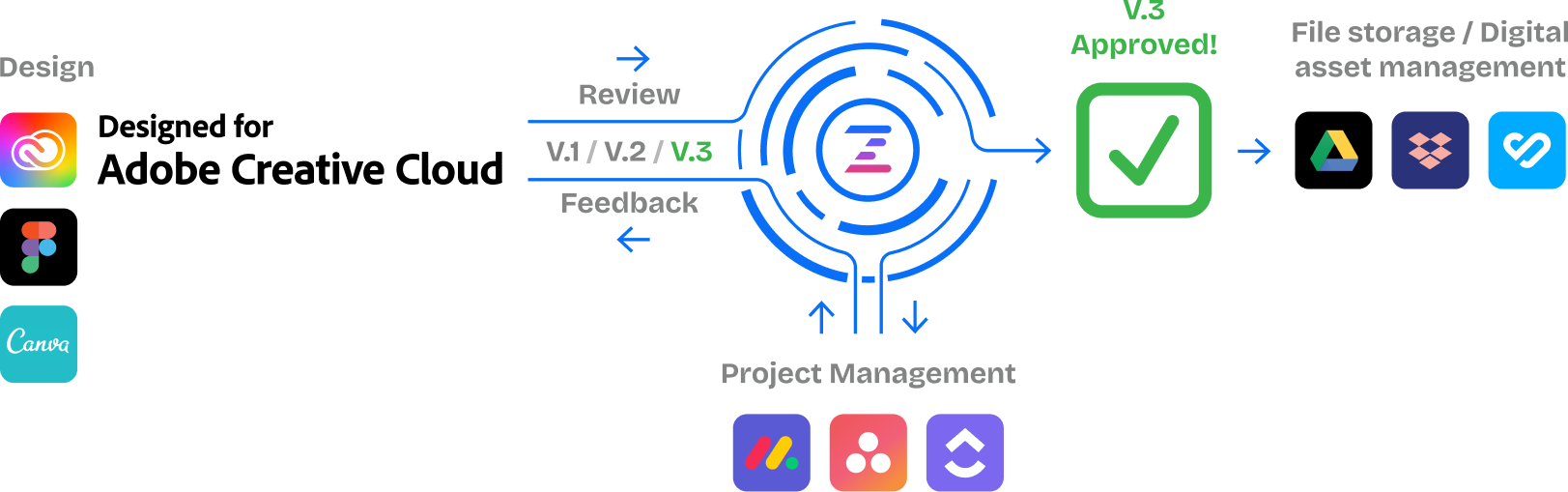
Here's what Ziflow brings to each pillar of creative asset management:
- Centralized review across 1,200+ file types in one interface, including video, static design, PDFs, audio, and live websites without switching tools
- Customizable multi-stage workflows with sequential and parallel options, conditional routing, SLA triggers, and automated reminders
- Inline annotation that keeps feedback pinned directly to the asset rather than scattered across separate threads
- Version control that locks previous iterations and makes changes between versions immediately visible
- ReviewAI for automated first-pass checks that catch issues before human review begins
- Full audit trail with e-signature support and enterprise security certifications for teams in regulated industries
For teams that want to see how it all fits together, the Ziflow product overview covers the full platform.
If your current process relies on email approvals and shared drives, getting started with Ziflow is the fastest way to see what a structured workflow actually looks like in practice.
Creative asset management FAQs
What is creative asset management software?
Creative asset management software gives marketing and creative teams a single platform to brief, review, approve, and track creative work from first draft to final file. Unlike a digital asset management system, which stores finished assets, creative asset management software governs the production workflow that produces them.
Is creative asset management the same as digital asset management?
No. Digital asset management (DAM) handles storage and retrieval of approved, final assets. Creative asset management governs the upstream production process: how work gets briefed, reviewed, revised, and approved before it ever reaches a DAM. Most teams that buy a DAM expecting workflow improvements still end up firefighting the same review and approval bottlenecks.
What are the benefits of creative asset management?
The main benefits are faster approval cycles, fewer revision rounds, no version confusion, full compliance documentation, and visibility into where every asset sits at every stage of production. Teams that operationalize all five pillars typically see review cycles shrink and on-time delivery climb.
Who needs creative asset management?
Any team producing creative work at scale. That includes in-house marketing teams, advertising agencies, video production teams, and creative functions in regulated industries like healthcare, financial services, and pharma, where audit trails and approval documentation are non-negotiable.

With a track record that spans media giants like WarnerMedia, Viacom, and Google, Aaron's expertise shines through in multi-million dollar projects across various mediums, from traditional television to the dynamic realm of YouTube.