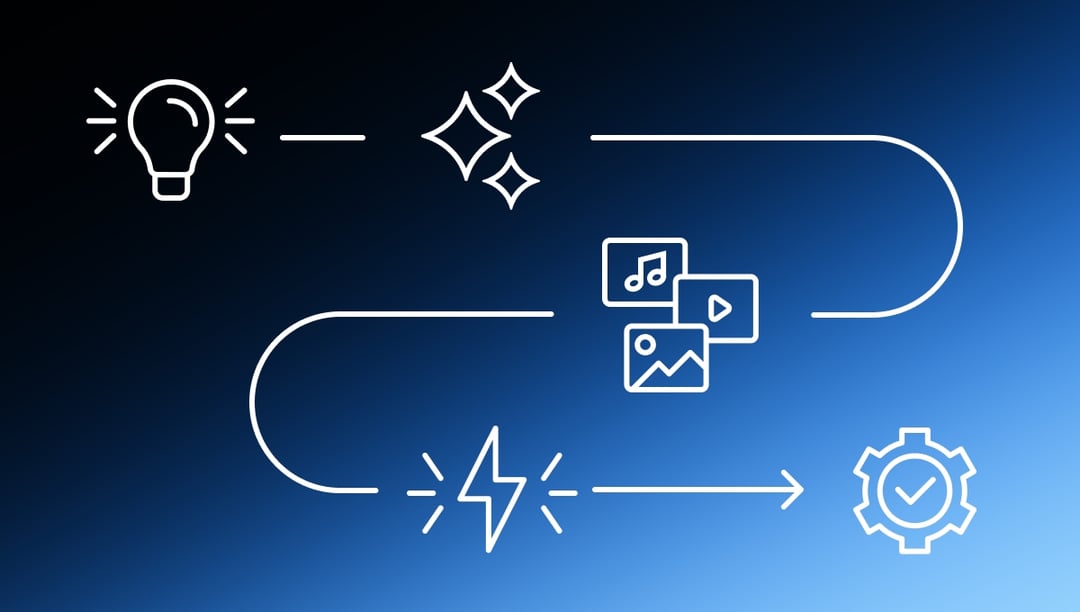
AI can generate an ad concept in seconds and churn out a dozen variations before you finish your coffee. But when it comes to approval, three weeks pass and someone has to fire up a passive-aggressive Slack thread.
Creative automation is the answer to this mind-numbing bottleneck. It's the use of technology and AI to handle repetitive creative tasks (think versioning, feedback routing, approvals) so your team can actually focus on strategy and storytelling. You know, the stuff that requires a human brain.
And no, we’re not talking about robots replacing designers. This is about letting machines do machine work so humans can do human work.
The reality is that creative production has exploded across every channel imaginable. Social, web, video, OOH, email, in-app notifications, the metaverse (kidding). But review cycles? Approval processes? Those haven't kept pace. They're still stuck in 2015, relying on emails, slacks, and dumb luck.
With creative automation, teams deliver faster, stay brand-aligned, and stop burning out over administrative tasks that machines should be handling. Ziflow’s AI system, ReviewAI, takes this further by automating creative processes intelligently, using context-aware assistance instead of rigid templates that make everything feel robotic.
What we'll cover
Table of contents
What slows down creative reviews without automation
Before we get to the good stuff, let's acknowledge the mess. Even talented teams lose momentum to manual processes. Here's where things typically fall apart.
Endless feedback loops
Feedback arrives via email… then Slack… then a Google Doc comment. Then someone mentions it in a meeting that nobody recorded. By the time you compile it all, half of it contradicts the other half, and the original deadline was yesterday. 80% of marketers encounter issues getting feedback on time, and those delays multiply when external reviewers enter the picture.
Lost or duplicated assets
Without automation, version control becomes a nightmare. You're working on v7, someone else is editing v5, and the client is reviewing v3 because that's what was attached to the email thread from two weeks ago. The infamous "final_final_v3_ACTUALLY_USE_THIS" filename exists for a reason.
Limited visibility across projects
Creative directors and stakeholders can't see where things stand. Is the banner approved? Is the video still with legal? Nobody knows, so everyone sends "just checking in" messages that clog up the whole operation.
Manual, repetitive reviews
Teams spend hours compiling feedback summaries, tracking changes across versions, and re-uploading assets to different platforms. This is not creative work, this is busywork masquerading as process. According to one study, 52% of companies miss deadlines due to approval delays and collaboration bottlenecks.
The cumulative effect is your best people spend their days chasing stakeholders instead of creating. Morale tanks, deadlines slip, and quality suffers because there's never enough time to actually think.
How creative automation speeds up production
We don’t want automation to replace creativity (it can’t anyway). We want automation to scale it. When repetitive tasks run themselves, your team can do what they're actually good at.
Deliver more content, faster
Automated versioning, asset generation, and proof routing accelerate time-to-market for every campaign. Enterprises using creative automation report up to 70% reduction in asset production cycles and 47% greater production capacity without adding headcount. That's not a typo.
Reduce repetitive manual work
AI can handle tedious tasks like file naming, tagging, and feedback summaries. This frees your team for high-impact creative thinking instead of administrative drudgery. Research shows creative teams spend only 19% of their time on actual creation; the rest disappears into coordination and approvals.
Improve brand consistency and compliance
Automation ensures every version follows the same brand and legal rules, minimizing off-brand errors before they happen. When you've got dozens of assets across multiple markets, this is the difference between coherent campaigns and chaos.
Drive collaboration and accountability
Centralized workflows make it easy to track who approved what, when, and why. No more "I thought you signed off on this" conversations. No more unverified assets sneaking through. Everyone sees the same source of truth, which means fewer miscommunications and faster resolution when issues arise.
The bottom line is that automation amplifies your team's capabilities without requiring you to hire more people or burn out the people you have.
How creative automation works
So what does this actually look like in practice? Here's the breakdown of the core capabilities that make creative automation actually useful, not just theoretical.
Assets automatically go to the right reviewers (design, brand, legal) via Automated proof routing, which is based on rules and project type. No manual assignment. No wondering if the right people have seen it. A video campaign for healthcare goes to compliance. A social post for the product launch goes to the brand team. The system knows, so you don't have to remember.
ReviewAI automatically groups and summarizes reviewer comments with AI-assisted feedback summarization, helping teams act on feedback faster. Instead of reading through forty-seven individual notes, you get the highlights organized by theme and priority. This alone can save hours per project, especially on complex campaigns with multiple stakeholders.
Automatically detect changes, flag outdated versions, and compare iterations side-by-side using smart version tracking. When someone tries to review an old version, the system redirects them to the current one. No more "wait, which version is this?" conversations. No more wasted time reviewing work that's already been superseded.
AI can suggest next reviewers or catch missing stakeholders based on past approval patterns using predictive approval workflows. If legal always needs to see the healthcare campaign, the system remembers that so you don't have to. This prevents the dreaded "we forgot to include legal and now we're two weeks behind" scenario.
Automate checks for brand consistency and regulatory requirements before assets go live. Upload your brand standards, and ReviewAI automatically flags violations during reviews, from logo placement to tagline usage to fonts and colors. Your brand stays consistent without requiring someone to manually check every asset against a 47-page guidelines document.
How to add creative automation to your review process
Ready to make this happen? Here's how to approach it without overwhelming your team or disrupting everything at once.
- Start with repetitive, rule-based tasks. Identify where automation saves the most time. Feedback summaries? Proof routing? Version tracking? Pick the tasks that eat up hours but don't require human judgment. These are your quick wins, the places where automation delivers immediate value with minimal risk.
- Maintain human oversight where it matters. Use automation for efficiency, not decision-making. Creative judgment still comes from your team. AI can flag that a logo is two pixels off-brand. It can't tell you whether the creative concept resonates emotionally. The goal is to give humans more time for that judgment by eliminating the administrative overhead that currently consumes their days.
- Integrate your creative tools. Teams can integrate ReviewAI with Adobe, Figma, and project management platforms like Monday.com, Asana, and ClickUp. The best automation fits into your existing workflow instead of forcing you to adopt entirely new habits. Your designers shouldn't have to leave Photoshop to get feedback routed correctly.
- Measure results and refine workflows. Track time saved, cycle speed, and revision counts to quantify creative automation's impact. Key metrics to watch include average review cycle time (target a 30-50% reduction), number of revisions per asset (watch for decreases), approval turnaround time, and time-to-market for campaign launches. These numbers tell the story of what's working and where you can improve further.
Scale your reviews with ReviewAI
When repetitive work runs itself, teams can focus on storytelling and innovation. That's the promise of creative automation, and ReviewAI delivers on it by handling the tedious stuff so you can get back to the work that actually matters.
ReviewAI is the bridge between automation and creativity. It automates intelligently while keeping the human touch intact. By offloading repetitive, rule-based tasks to AI, your team gains more time and mental space to deliver bold, high-impact creative work. No more drowning in administrative overhead. No more context-switching between feedback tracking and actual creative thinking.
Here's what ReviewAI does:
- Automatically checks your content against pre-set review criteria, catching issues before they become expensive problems
- Standardizes feedback across teams and stakeholders so everyone speaks the same language
- Ensures new asset versions reflect prior feedback and required changes, eliminating the "didn't we already fix this?" moment
- Confirms accuracy and traceability across revisions with a complete audit trail
- Reviews assets and flags violations of curated brand standards before anything goes live
The days of choosing between speed and quality are over. With creative automation, you get both. And your team gets to actually enjoy their jobs again.

With a track record that spans media giants like WarnerMedia, Viacom, and Google, Aaron's expertise shines through in multi-million dollar projects across various mediums, from traditional television to the dynamic realm of YouTube.